Where to Buy

FAQ

  • A Guide to Torque Values

    It should be understood that the subject of Torque Tension loading is beyond the scope of this Guide to Torque Values. It is an acceptable guide for normal conditions; for critical applications, however, further information and research will be necessary.

    Please ensure that you read all of the information provided.

  • Calibration

    A simple definition of calibration is the comparison of a device against a known standard in order to establish the accuracy or error of the device.

    All calibrations are subject to uncertainty because it is not possible to know the exact value of every quantity that may affect the calibration. Increasingly customers are recognising the importance of uncertainty values on a calibration.

    Many manufacturers quote "traceability" to NIST (the US National Institute of Standards and Technology) or NPL (the UK National Physical Laboratory) but that traceability statement is not of much value without a statement of measurement uncertainty.

    Countries around the world have agreed Mutual Recognition Agreements between their laboratories.

    The best laboratories are those who have been accredited by their national organisation to ISO17025. This standard replaces "ISO Guide 25" and is the ISO9000 of the calibration world.

    "As Found" calibrations are those in which the status of the device is established as received by the laboratory from the customer.

    "As Left" calibrations are those showing the status of the device after adjustment. It is important to discover the "As Found" status before adjustment. If the device was out of tolerance the user may need to consider corrective action as required by ISO9000.

    Adjustment of torque wrenches and torque transducers consists of altering the slope of the input - output line, and of altering the zero intersection on the y axis.

  • When do I need to recalibrate my torque wrench?

    The European Standard clearly states that 'For the first recalibration, the period of validity starts with the user's first operation of the torque tool'. So the important thing to remember is that it is 5,000 cycles or 12 months from the user's first operation and not from the date of manufacture.

    View further information on Calibration Periods for Torque Wrenches.

  • Formula for Calculating the Effect of Torque Wrench Extensions

    Formulae

    Accepted formulae relating  torque and tension, based on many tests are:-

    For Imperial Sizes

    M = P x D M = torque lbf·ft P = bolt tension lbf D = bolt diameter (ins)
     60


    For Metric Sizes

    M = P x D M = torque N·m P = bolt tension Newtons D = bolt diameter (mm)
           5000
     
    These formulae may be used for bolts outside the range of the tables
    Formulae for Calculating the Effect of Torque Wrench Extensions
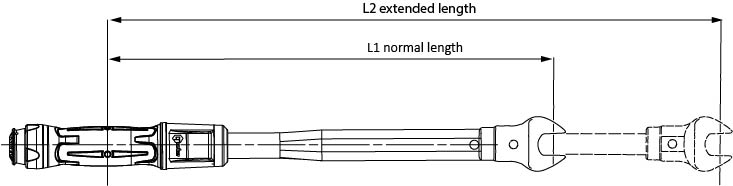
    M1 = M2 x L1/L2    Where L1 is the normal length and L2 is the extended length, M1 is the set torque and M2 the actual torque applied to the nut.


    Example

    The required torque on the fastener is 130 N·m (M2) but what do you set on the torque wrench scale?
     
    L1 = 500 L2 = 650
    (units of length not important, this is ratio)


    M1 = 130 x 500/650

    M1 = 100
    The Torque Wrench Extension Calculator can do all the calculations for you.

  • Torque Helpline

    Most users of torque equipment have their own job to do and our products are there to help. If you have any questions about torque tightening of fasteners, application of torques, or calibration of devices we will do our best to help. Check out our FAQ section, and if you can’t find the help you are looking for, contact us at help@norbar.com.

    Norbar also offers a live chat function which is visible on the bottom right on the Norbar website and a contact enquiry form which can be found here

    If your question is urgent, remember that most of the day or night there is a Norbar office open somewhere in the world.

    United Kingdom:   + 44 (0)1295 270333
    Adelaide, Australia:   + 61 (0)8 8292 9777 
    Ohio, USA:   + 1 866 667 2272
    Shanghai, China:  + 86 21 6145 0368
    India:  + 91 22 47788110
  • Accuracy

    Manufacturers use different ways to claim accuracy of the torque wrenches and measurement equipment.

    "Percentage" or "Percentage Full Scale" means that the figure is multiplied by the full scale of the device, and this value applies across the range of the device.

    Besides the accuracy, it is important to find out the uncertainty of calibration. There are torque standards such as BS7882 and DIN51309 that combine accuracy and uncertainty into a class. The device is then classified to take account of its own uncertainty as well as the uncertainty of the calibrating equipment.

    Most torque devices are assumed to have a straight line performance. The linearity of the device is a measure of how close to a straight line its performance actually is.

    The accuracy of a torque wrench can be affected by the use of adaptors, extensions, crowfoot spanners etc.

  • The Importance of Torque Management

    View Norbar's Mangaging Director, Neill Brodey's Question and Answer Article shown in 'FAST' magazine, July 2010

    Reproduced with permission from © 2010 NewbyCom Limited

  • l've got a tool that I need to return to Norbar in the United Kingdom, what do I do?

    Please download the 'Goods Return Form'. Complete all compulsory fields, print a copy and enclose with the goods being returned.

  • The checking and calibration of torque wrenches
  • Why is it necessary to tighten fasteners accurately?
  • The selection and use of torque wrenches
  • Getting the Best out of your Torque Tester - Part One
  • Getting the Best out of your Torque Tester - Part Two
  • Measuring The Torque Output of Impulse Tools
  • Should I wind my Torque Wrench back to Zero after use?

    No. A torque wrench should never be wound back to zero. If adjusted after use, it should only be returned to its minimum marked scale setting (typically around 20% of maximum capacity), and never below this point.

    Why you should not wind a torque wrench back to zero.

    • Setting a torque wrench below its minimum scale marking can adversely affect calibration
    • Winding to zero can reduce long-term accuracy and tool reliability
    • Torque wrenches are designed to operate within a defined calibrated range

    Should a torque wrench be wound back after use?

    It depends on how the wrench is used:

    • Occasional use: If convenient, return the wrench to its minimum scale setting after use.
    • Frequent or production use: Leaving the wrench set between uses will not cause damage, provided it is used correctly and within its specified torque range.

    Extensive testing shows that factors such as misuse, overloading, impact, or general handling have a far greater influence on calibration accuracy than whether the wrench is left set above its minimum value.

    Best practice summary.

    • Never wind a torque wrench back to zero
    • Do not adjust below the minimum scale marking
    • Returning to the minimum setting is optional, not mandatory
    • Correct use and handling are more critical to accuracy than winding back
  • How do I change a wheel on my car?

    Do you know how to correctly change a wheel on your car in the event of a puncture? Follow these steps and advice to change your wheel safely and get your journey under way again

Testimonials